Category Archives: Uncategorized

U.S. Fish and Wildlife Service on How Does Wildfire Impact Wildlife and Forests?

October 16,  2022 – By Meghan Snow – Seeing a forest recently burned in a wildfire can be jarring. Green is replaced by shades of gray. The land is quiet. The sunshine feels hotter. However, it’s not long before the forest comes back to life.

“Wildlife is incredibly resilient,” said Stephanie Eyes, a senior wildlife biologist for the U.S. Fish and Wildlife Service’s Sacramento Fish and Wildlife Office. “California has a long history with wildfire, and many species adapted to endure it.”

Eyes has evaluated the impacts of wildfire on wildlife for more than a decade. Before joining the Service, she worked for Yosemite National Park, surveying the impacts of fire on California spotted owl. Today, she uses data collected on wildfires to determine the impact on habitat for endangered, threatened and at-risk species living in the Sierra Nevada.

Fires burn at different heat levels, can be large or small, and cause varying impacts on the land, wildlife, and nearby communities. Topography, the amount of dry vegetation present and weather factor into how large and damaging the fire becomes. Low-intensity fires burn close to the ground, “cleaning” and thinning the forest by removing thick and flammable vegetation from the forest floor. High-severity fires burn with high heat, climb into and remove the tree canopy, and can scorch the soil and tree roots. At a large scale, high-severity fires can be incredibly damaging to wildlife and the ecosystem. Mosaic fires are a mix of mostly low-intensity fire with patches of high- and moderate-severity fire and some unburned forest. Wildlife can survive, and even thrive, in areas that experience mosaic fires.
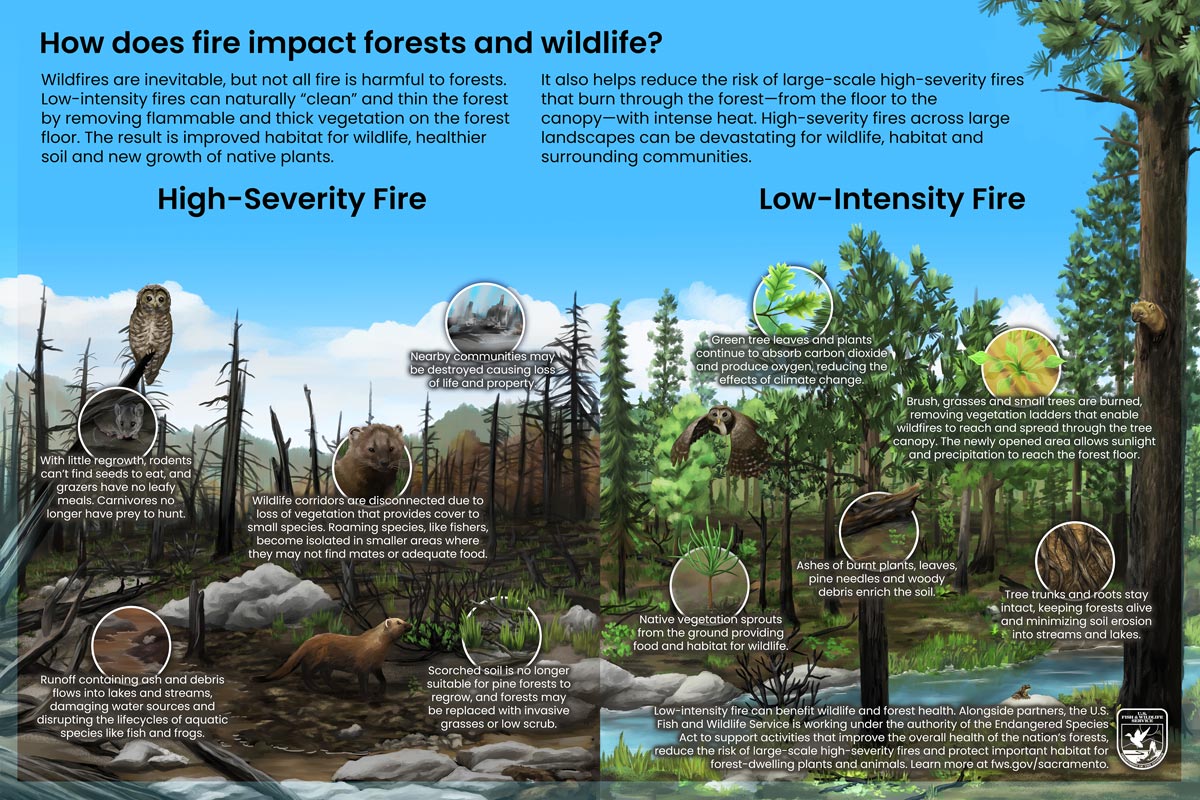
forest fire final credit USFWS

When wildfires erupt, animals do their best to move out of the direct path of the flames while staying close to home if they can find safe refuge.

“Wildlife will move around their home area, avoiding the smoke and actively burning areas until it’s safe to return,” explained Eyes. 

Some animals, like frogs and rodents, don’t move far. They’ll retreat into deep underground burrows where they are protected from the heat. Fish and frogs will swim to the deepest parts of their stream or lake. If the fire is burning just a few feet high, birds and animals that can climb will sometimes go up into the branches and tree canopy to avoid the flames. Fishers may crawl into a tree cavity for protection. Other animals, like deer and bears, will move around the forest until the flames subside.

“When I was working in Yosemite, there was a female California spotted owl who weathered several wildfires. We were always concerned about her, but she would still be there, year-after-year,” said Eyes. 

But when a high-severity fire burns across a large landscape, it moves fast and climbs through the tree canopy. Wildlife has a more challenging time finding refuge from these flames.

“Wildlife have adapted to deal with smaller fires, and unfortunately, sometimes they can’t escape these recent, big fires,” said Eyes.

The Service listed the southern Sierra Nevada fisher in 2019 and the Sierra Nevada red fox in 2021, both as endangered species. High-severity wildfires were identified among the leading threats to the ongoing survival of both species due to loss of habitat and elimination of safe movement corridors. As climate change prolongs periods of drought, forests and the species that live there will continue to face the threat of large, high-severity wildfires.

AFTER THE BURN

Over the past seven years, high-severity wildfires burned thousands of acres across California. Unprecedented drought mixed with mid-summer lightning storms ignited wildfires so large they created their own weather systems. While many areas burned severely, pockets of forest continue to thrive.

Nancy Kelly, a wildlife biologist for the U.S. Forest Service’s Sequoia National Forest, has worked for more than 20 years surveying and studying wildlife habitat.

“The adaptability of wildlife continues to surprise me,” said Kelly. “They can make do with what’s left after a fire.”

As a wildlife biologist, Kelly advises staff at Sequoia National Forest on ways to reduce the impact of management activities, such as prescribed burns and tree thinning projects, on endangered, threatened and at-risk species.

“Initially, fire is a big deal. It changes how species interact with their habitat for a long time,” said Kelly. “But fire is a tool that nature has been using for eons to keep ecosystems intact.”

After low-intensity fires, grasses and ferns are the first to come back, aided by newly enriched soil from the ashes of burned leaves, plants, and woody debris, as well as sunlight that can now reach the forest floor. Trees are still alive and sprout new leaves during the next growing season. Their intact root systems prevent soil from eroding into nearby streams and lakes.

“We have seen populations of sensitive plants double after a fire because they like the open canopy,” said Kelly. 

It doesn’t take long for wildlife to start using low-intensity burn areas. New grasses, ferns and fallen branches provide just enough coverage for mice and squirrels to feel safe as they scavenge for seeds dropped during the fire. Their presence attracts owls, fishers, foxes and other animals that take advantage of newly opened areas on the forest floor to spot prey. Tender grass shoots provide food for herbivores like deer and rabbits. Amphibians scramble back to their waterfront homes to feast on insects that have also returned.

“We will see wildlife come back through the area as it cools back down,” said Kelly. “They’re curious like we are. They take advantage of the new growth and other food sources that are available after the burn.”

Regrowth after a large-scale, high-severity fire looks different. Some of the soil is scorched to a degree that tree roots underneath the surface are burned, killing the tree. Ash from leaves and woody debris may take longer to breakdown and enrich the soil to a point that vegetation can sprout from the ground. Rain can often cause the soil to erode into nearby waterways. Muddy waters result in less clean water sources for animals to drink from and can also bury amphibian and fish eggs before they hatch.

“While these high-severity burn areas look like moonscapes, they are not completely devoid of life. It’s just different life,” explained Kelly. 

Woodboring beetles start colonizing the freshly burnt trees. Woodpeckers move in to eat the beetles. The dead trees fall, their ash providing much needed nutrients to restore the soil.

“Unfortunately, in some of these large, high-severity burns, we’re seeing more invasive grasses and weeds grow because they can survive in less ideal conditions,” said Kelly. “These species can outcompete native grasses and plants for water and light.”

One native plant, mountain white thorn, grows low to the ground when forest canopies are present. But after a high-severity fire, the shrub can regrow to heights over 6 feet. Their growth then blocks sunlight to tree seedlings sprouting from the ground, and the landscape can transition from forestland to scrubland.

Kelly explained that sometimes the animal life after a fire transitions, too.

“This year, we’ve seen red-tailed hawks and other grassland bird species because we have more open area now,” she said. “Until trees come back, I expect that we’ll continue to see these grassland and open area species in the mountains.”

TO STAY OR GO

More than 100 years could pass before large trees return to the landscape after a high-severity fire, and some species can’t survive without the forest canopy, even if they try.

“California spotted owls can find places to perch, but they can’t find good places for nesting,” said Eyes. “Just like us, if they don’t have a roof over their heads, they’ll leave.”

Fishers also avoid the open landscapes, which leave them vulnerable to predators as they move between their dens and scavenging grounds. Fishers often travel miles looking for food, mates and good reproductive habitat, but high-severity wildfires can often cut off those safe travel corridors, restricting them to smaller and smaller ranges and reducing their chances of finding a mate and enough prey.

Luckily, agencies like the U.S. Forest Service, National Park Service and Bureau of Land Management work to restore habitat after large fires like these.

“If a prescribed burn can be used to reduce the risk of a high-severity fire or vegetation can be planted immediately after the fire, the wildlife will typically come back,” said Eyes.

The Sequoia National Forest conducts a variety of activities aimed at reducing the risk of large-scale, high-severity fire, such as prescribed burns, brush management projects and thinning overgrown groves of trees. Kelly works with biologists at the U.S. Fish and Wildlife Service to determine ways to minimize the impact on listed species in the area. While the projects cause some minor disruption while they’re taking place, the period is usually short and much less disruptive and damaging than a high-severity fire.

Kelly and her team also support the restoration of burned landscapes by replanting native vegetation and trees on open slopes and near streams to reduce erosion and jump start the process of bringing the area back to life.

“The forests provide the food, water and shelter for wildlife, but they’re also important to humans,” said Kelly. “By taking care of the forests, we’re also taking care of our air, water sources and communities.”
Source: USFWS


Care to Share?

Stanford Researcher on Empowering Private Landowners to Prevent Wildfires

4633 p1 20190905humboldtprescribedburnLQD32
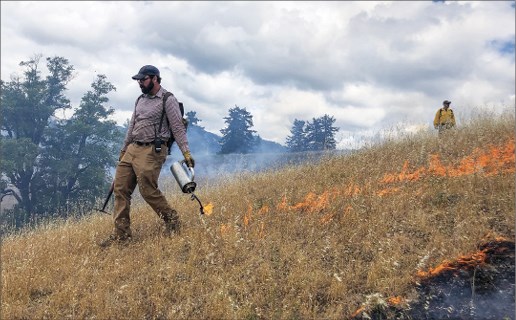
Brad Graevs of the Plumas Underburn Cooperative uses a drip torch to set fire to vegetation in Humboldt County as part of a controlled fire in June organized by the Humboldt County Prescribed Fire Association. Photo/Lenya Quinn-Davidson

Controlled burning has proven effective at reducing wildfire risks, but a lack of insurance has dissuaded private landowners from implementing the practice. Policy expert Michael Wara discusses soon-to-be-enacted legislation that would pay for fire damages to neighboring properties in California.

September 27, 2022 – By Rob Jordan,Stanford Woods Institute for the Environmen – Ironically, after California’s deadliest and most destructive wildfire season ever – in 2018 – insurance companies stopped providing coverage for one of the most promising ways to prevent such catastrophes.

To slow the scourge of wildfires, California needs controlled or prescribed burning of tinder-dry trees and brush known to fuel runaway wildfires – or vegetation thinning on about 20 million acres or nearly 20% of the state’s land area. Although more than 50% of the state’s land belongs to private owners, they have largely avoided prescribed burning in part due to fears of bankruptcy, according to previous Stanford University research. To assuage those fears, Stanford legal research scholar Michael Wara, in partnership with The Nature Conservancy and University of California Agriculture and Natural Resources fire advisors, assisted California state Sen. Bill Dodd in the development of legislation that would implement a $20 million fund to pay for prescribed fire damages to neighboring properties through 2028. The bill – SB 926 – received almost unanimous support from the state legislature, and awaits Gov. Gavin Newsom’s signature before it is finalized.

Below, Wara, director of the Climate and Energy Policy Program at the Stanford Woods Institute for the Environment, discusses how to restart the insurance market for prescribed burning on private land, dispel misconceptions about the practice, and surmount related obstacles.

This past April, mistakes in a routine U.S. Forest Service prescribed burn led to New Mexico’s largest wildfire ever. What impact will that have on prescribed burning in California going forward?

CalFire – the California Department of Forestry and Fire Protection – is a bit more anxious about prescribed fire than perhaps they were before New Mexico. But there are many different flavors of prescribed fire. SB 926 helps private landowners with smaller fires than what escaped in New Mexico. That fire was supposed to be 2,500 acres. Most prescribed burns on private land are about 10 acres, so there’s a lot less potential for damage. But there are far more of them conducted – more than 400 over the past few years – than is typical for the forest service.

Is the insurance industry’s risk aversion for prescribed burnings justified?

Based on our analysis over the past three years, only two out of 400 prescribed burns on private property in California have escaped. And when you say “escaped,” it doesn’t necessarily mean damages. They burned a little more than planned. A cattle grate was damaged in one case. The risk is really low, at least as far as we can tell from the actual data. CalFire has had two escapes in the past three years that did more damage and required more attention, but again, that’s a different beast from burns on private property.

What can be done to encourage insurers to issue policies for prescribed burn coverage?

Writing or issuing commercial fire insurance and reinsurance is not how you get promoted in the insurance industry. We need to change that. Lenya Quinn-Davidson of University of California Agriculture and Natural Resources and I are trying to build a much more comprehensive assessment of what the risk actually is. Bringing insurers into the market requires actuarial analysis. We want to replace preconceived notions and fears with data. Maybe you won’t sell me an insurance policy that covers that first loss, but maybe you would sell me one that covers loss above some very high deductible – maybe $2 million – because those losses are unlikely to occur.

Is a $20 million liability fund that only covers private land enough to make a dent in the massive amount of prescribed burning California needs to do?

This bill is a pilot. It’s intended to see what happens, see what we can learn. This is a targeted, surgical intervention to help a particular set of people who we think could play an important role in reducing risk. I think of them as the Good Samaritans of fire. They are going out on their weekends, getting paid nominal money if anything, and working to make their communities safer. How to better manage private lands for fire risk in California is a huge issue. The odds these parcels are important go up as you get closer to communities. A lot of this is aimed at protecting small-town California. These places where there’s a lot of risk, you’ve also got lots of private landowners.

Some people are concerned by the prospect of frequent, purposefully set fires. What can be done to reassure them?

The way public opinion on prescribed fire changes is with engagement. Community meetings, personal experience, and accurate depictions in trusted media are key. In general, when that kind of work is done, there’s tremendous support. This bill will make it easier to have more of those interactions. Financial support for prescribed fire work is available; the real challenge now is these liability issues.

How do Native tribes that have done controlled burning for millennia figure into this?

Work remains to be done figuring out how to incorporate cultural burning into a claims fund process – it’s an unfinished aspect of this pilot. I would hope before we move toward a permanent solution, we solve that problem. And this is one of the things our Smoke Policy Lab will be working on this year, in partnership with the Karuk Tribe Department of Natural Resources. (Read more about the policy lab.)

What other major obstacles to prescribed burning remain? How can we overcome them?

The real limiter for doing prescribed burning in California is having trained personnel available and having backup units available. If CalFire doesn’t have resources to stand by, a burn won’t happen. If we’re going to change the fire ecology of the state – which is really what we need to do to keep communities safe – we need to train an army of people. It implies a huge investment in rural California and lots of jobs. We need as much emphasis on good fire as we currently have on fire suppression.

Why should Californians who don’t live near wildfire-prone areas care about this bill?

Anybody that lives in L.A. or the Bay Area or the San Joaquin or Central Valley over the past five years has experienced terrible air quality. Stanford scholarship from Kari NadeauMary PrunickiMarshall Burke, and Sam Heft-Neal has made this point in many different ways. Prescribed fire makes a little bit of smoke to avoid a very large volume of smoke. You can choose the day and weather conditions so the smoke doesn’t expose people in communities downwind. While our understanding of the impacts of wildfire smoke is developing rapidly, the more we are learning, the more serious the threat to public health seems to be.

Wara is also interim policy director for the Sustainability Accelerator at the Stanford Doerr School of Sustainability.

Source: Stanford


Care to Share?

Over the Garden Fence – The Partnership Between Humans and Nature During Fire Recovery: Part 5

Do your part to prevent human caused wildfire: Part 5 

Over the Garden FenceSeptember 26, 2022 – By Michele Nowak-Sharkey, UC Master Gardener of Mariposa County – The largest natural cause of fire is lighting. However, most fires are human caused. The percentage varies from 89% – 95% depending on the source. With the increase in drought, fuel build-up in unburned forests, earlier springs, higher temperatures, beetle infested weakened trees, with the addition of a bit of wind and the same actions that might have easily extinguished a small fire in the past are now creating dangerous infernos.
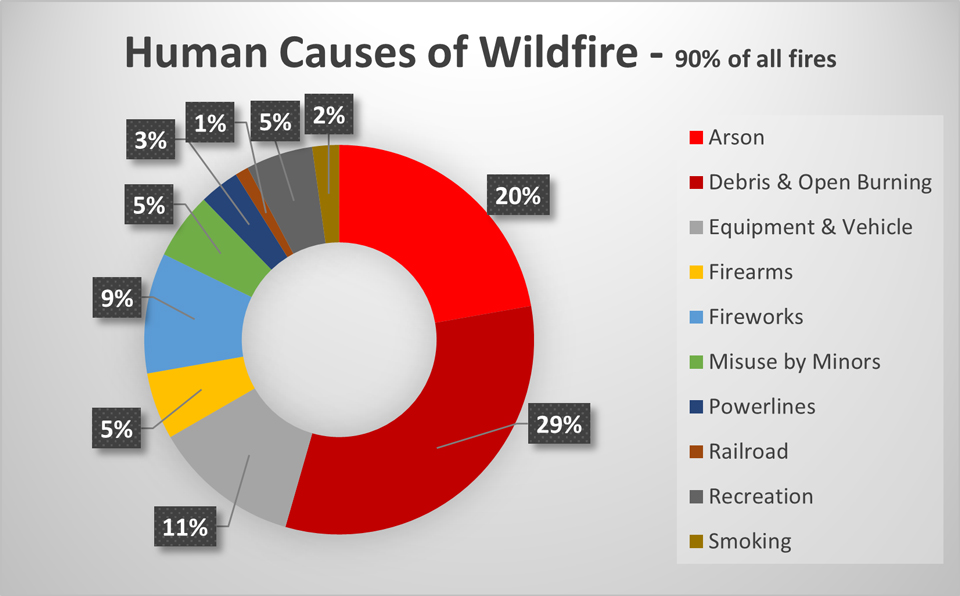
Being aware of our everyday choices can impact the number and magnitude of fires in the future.
(https://www.nifc.gov/fire-information/fire-prevention-education-mitigation/wildfire-investigation)

MMG Human Causes of Wildfire

Debris and open burning include burn piles, yard debris, burn barrels, ditch/fence line burning, pest control, open trash burning, burning personal items, distress/signal fires, land clearing, right-of-way hazard reduction, or other escaped controlled burning. Windblown embers or fire creeping from the control burn area into un-cleared vegetation are the primary ignition mechanisms.

How to prevent: Landscape debris piles must be in 4 feet by 4 feet piles.  Clear all flammable material and vegetation within 10 feet of the outer edge of pile.

Keep a water supply and shovel close by.

A responsible adult is required by law to be in attendance until the fire is out.

Stay mindful of current weather conditions when burning. If it’s windy and the surrounding vegetation is very dry, it may be best to wait and burn another day.

Check Mariposa County for burn permit requirements. 209 966-1200. (https://cemariposa.ucanr.edu/Fire_Information/Permits_and_Regulations/Mariposa_County_Permitting)

Arson is the criminal act of deliberately or maliciously setting fire to property including public lands with the intent to damage or defraud. Devices and “hot sets” are commonly used to ignite fires.

How to prevent: If you see or know of unusual activity in an area where wildfires are occurring, report it immediately. Note descriptions of vehicles and people in the area including dates, times, and location. Photos and videos are extremely helpful!

Equipment/Vehicle fires range from heavy construction to small portable engines (passenger vehicles/RVs, motorcycles, OHV, ATV, trailers, road graders, bulldozers, tractor trailers, welders, grinders, wind generators, chain saws, pumps, generators, etc.).

Ignitions sources are mechanical breakdowns/malfunctions such as exhaust (direct heat transfer, organic material collecting on the exhaust system, and particles), catalytic converter pieces, hot metal fragments, metal/pavement contact (dragging trailer chains and metal parts), friction, flat tires, spark arrestor malfunctions, faulty electrical system/wiring, collisions, refueling operations, and rock/hard surface strikes.

How to Prevent: Perform regular maintenance on your vehicles – secure chains, inspect for dragging parts, check tire pressure, and properly maintain brakes. Visit Ready for Wildfire equipment use for more prevention tips. (https://www.readyforwildfire.org/prevent-wildfire/equipment-use)

Firearms and explosives use requires being aware of any firearm projectiles along with flares from flare guns and signal flares.

How to Prevent: Explosives, exploding targets, incendiary ammunition and tracer bullets are prohibited on public lands during high fire danger. Check for fire restrictions and prohibited uses in the area. To prevent wildfires while target shooting, follow these tips:

Bring a shovel and water or fire extinguisher.

Place your targets on dirt or gravel, clear and away from grass and other vegetation.

If fire danger is high (dry, hot, and windy) consider shooting at an established outdoor or indoor range.

Know your ammunition – don’t shoot steel component, tracer, or incendiary bullets.

Bullets can spark when striking solid objects, sending hot fragments into vegetation – don’t shoot trash like TVs and appliances or at rocks and metal targets such as signs.

Fireworks burn at extremely elevated temperatures making all fireworks ignition sources especially the airborne type (i.e., bottle rockets and roman candles). Even sparklers burn at 1200°F.

How to prevent: Despite the dangers of fireworks, few people understand the associated risks – devastating burns, other injuries, fires, and even death. During times of high fire danger, federal and local agencies impose fire restrictions and/or fire prevention orders.

Misuse of fire by minors has its own category. Young children, ages 12 or younger, motivated by normal curiosity may use fire in an experimental fashion; “playing with matches.” They look for easily accessible ignition devices and frequently use both paper and wood matches, lighters, fireworks, or magnifying glasses to ignite fires.

How to prevent: Set a good example and teach children fire safety at an early age. The most critical message for children to learn is that matches, and lighters are tools and not toys! Parents should never use lighters, matches and fire for fun – children will mimic the behavior,

Power line caused wildfires are often due to high winds, contact with vegetation, equipment failure, or human or animal contact with a power line (conductor wire). Several of these factors may work to cause a fire, such as wind blowing vegetation into contact with the electrical equipment.

How to prevent: Proper maintenance including vegetation clearance around equipment can help prevent wildfires. For your safety, however, stay away from power lines, meters, transformers, and electrical boxes. Leave the maintenance to the professionals – if you see vegetation close or in contact with power lines or bird nest close to the lines or conductor boxes, notify your utility company.

Recreation and ceremony include campfires improperly constructed, unattended, improperly extinguished, or abandoned; barbeque/smokers; bonfires; ceremonial fires; gas cookers, warming and lighting devices; luminary (sky lanterns); and outdoor fireplaces, metal fire rings and candles.

How to Prevent: Learn how to construct a proper campfire and how to put it out. (https://smokeybear.com/en/prevention-how-tos/campfire-safety) Never leave grills and smokers unattended. Watch weather conditions closely when considering have a bonfire, ceremonial fire or using candles.

Smoking fires are generated from discarded unextinguished cigarettes and other materials used for smoking. Wildfires caused by smoking activities or accoutrements, include matches, cigarettes, cigars, pipes, electronic cigarettes (vape heads), and drug paraphernalia.

How to Prevent: Never flick cigarette butts out the window. Watch where you toss used matches and other smoking accoutrements. Beware of wind conditions when using such paraphernalia.

We want to get back to fire as a beneficial effect on the landscape rather than a damaging effect.

As Smokey says “Only YOU can help prevent wildfires” by our personal actions and the actions we take as a community.

Next Up: Defensible Space and How to Create It

Related:

Over the Garden Fence – The Partnership Between Humans and Nature During Fire Recovery: Part 4

Over the Garden Fence – The Partnership Between Humans and Nature During Fire Recovery: Part 3

Over the Garden Fence – The Partnership Between Humans and Nature During Fire Recovery: Part 2

Over the Garden Fence – The Partnership Between Humans and Nature During Fire Recovery


For assistance, contact our Helpline at (209) 966-7078 or at mgmariposa@ucdavis.edu. We are currently unable to take samples or meet with you in person but welcome pictures.

The U.C. Master Gardener Helpline is staffed; Tuesdays from 9:00 A.M. – 12:00 P.M. and Thursdays from 2:00 P.M. – 5:00 P.M.
Clients may bring samples to the Agricultural Extension Office located at the Mariposa Fairgrounds, but the Master Gardener office is not open to the public. We will not be doing home visits this year due to UCANR restrictions.

Serving Mariposa County, including Greeley Hill, Coulterville, and Don Pedro
Please contact the helpline, or leave a message by phone at: (209) 966-7078
By email (send photos and questions for researched answers) to: mgmariposa@ucdavis.edu

For further gardening information and event announcements, please visit: UCMG website: https://cemariposa.ucanr.edu/Master_Gardener
Follow us on Facebook at: https://www.facebook.com/mariposamastergardeners

Master Gardener Office Location:
UC Cooperative Extension Office,
5009 Fairgrounds Road
Mariposa, CA 95338

Phone: (209) 966-2417
Email: mgmariposa@ucdavis.edu
Website: http://cemariposa.ucanr.edu/Master_Gardener

Visit the YouTube channel at UCCE Mariposa.


Care to Share?

DWR Funded Project Provides Support to Firefighters During Oak Fire

DWR Funded Project Provides Support to Firefighters During Oak Fire

Published: 


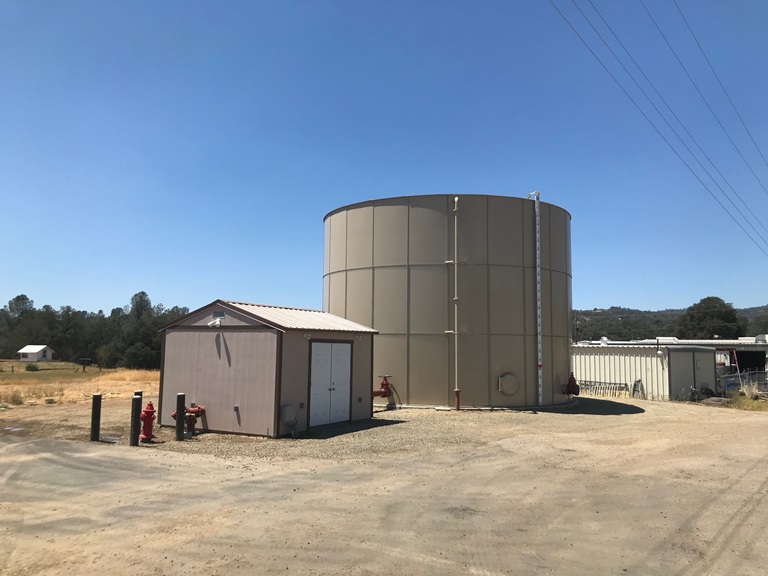
Image of new DWR-funded water tank at fire station in Bootjack (Mariposa County).
Image of new DWR-funded water tank at fire station in Bootjack (Mariposa County). Photo credit: Mariposa County Resource Conservation District

With temperatures rising and climate change increasing drought conditions in California, a project funded by DWR provided critical fire-fighting support to the Mariposa community by strengthening local water supply infrastructure as they battled one of the largest wildfires of 2022.

The Mariposa County Resource Conservation District was awarded $700,000 in 2020 from DWR’s Integrated Regional Water Management (IRWM) program. This funding supported a project called the “Bootjack Fire Station Water Storage Project”, which included the installation of a new water tank at a local fire station in the disadvantaged community of Bootjack. The project’s purpose was to increase local water storage to fight the growing number of wildfires in the region.

The district installed the new tank in the spring of 2022 and finalized testing before receiving a certificate of completion in mid-July. A few days later, the Oak Fire ignited and quickly devoured more than 19,000 acres and 124 structures in the community.

Located south of the fire, the new water tank helped firefighters respond quickly by supplying easily accessible water to water tenders. Water tenders are used to help firefighters transport water from a water to the scene of the fire. The new system can now fill two water tenders in 10 minutes and reduced the turnaround time for water tenders replenish their water supply and return to the scene from 60 minutes to 30 minutes.

As of August, the tank provided 500,000 gallons of water for firefighting and mop-up operations, including dowsing burning ashes and extinguishing other burning materials. County fire personnel also shared that the tank helped save some homes in the area.

The raging fire is now under control. Representatives from the district attribute the new system for part of the success of putting out the fire.

“We cannot express our gratitude enough to the Department of Water Resources and their IRWM program. The new Bootjack water tank played a crucial role by assisting firefighters in stopping the fire’s eastward progress and steering it north where its intensity was reduced,” said Melinda Barrett, executive director of Mariposa County Resource Conservation District. “Because of this tank, many residents were able to return to their homes.”

“This project is a great example of integrated watershed management and successful collaboration between state and local government. DWR will continue to provide necessary financial assistance to help protect our communities as California’s climate shifts to longer drier periods,” said Carmel Brown, manager of the Financial Assistance Branch at DWR.

Funded by voter-approved Proposition 1, DWR’s IRWM Program supports projects that respond to local challenges by improving water supply reliability, reducing fire risk, increasing water storage, and improving water quality while adapting for future challenges caused by climate change and drought.

An additional impact from California’s ongoing drought and warming temperatures includes elevated wildfire risk. California’s climate in this century has been drying and warming, and statistics provided by CAL FIRE show that many of the largest and destructive wildfires in California have occurred since 2000.

DWR’s IRWM program is currently accepting applications for the second round of implementation funding to help address these impacts and expects to announce the first phase of awards later this fall and the second phase in spring 2023. Applicants must coordinate through their respective established IRWM Regional Water Management Group and can submit grant applications using DWR’s online submittal tool, GRanTS.

With dry and hot conditions pointing to a fourth year of drought in California, the state remains committed to help communities strengthen local and regional water resilience. For more information about upcoming funding opportunities, visit DWR’s Grant and Loans webpage.


Care to Share?

Over the Garden Fence – The Partnership Between Humans and Nature During Fire Recovery, Part 1

August 26, 2022 – By Michele Nowak-Sharkey, UC Master Gardener, Mariposa County – Wildfire has entered our common vocabulary over the past 15+ years across California and Mariposa County.

From the Telegraph Fire in ‘08 to the Washburn, Agua and Oak fires, Mariposa County has experienced unpredictable blazes, resulting in ash strewn hills of black and gray. In fire-burned areas, it looks as Over the Garden Fenceif it will always be this way.

And yet for landscape recovery after fire, “time heals all wounds.” Nature heals. As stewards of the land where we have built our community, we can partner with nature to support healing of the places we love.

Over the next few weeks this series will offer suggestions about working with nature when fire has touched your land and how to help prevent fire spread if it happens again.

Sources for best practices in returning to and rehabilitating property after fire: https://www.mariposacounty.org/2644/Returning-After-the-Fire.

The following is adapted from the California Native Plant Society Fire Recovery Guide: https://www.cnps.org/give/priority-initiatives/fire-recovery.

Things to consider during the clean-up and rebuilding after fire:

  1. Minimize foot traffic, equipment, and disturbances to the landscape. Activity on charred ground can compact the soil lowering water absorption and increasing runoff.

Create a traffic pattern for equipment and parking vehicles. Decide on a place for debris and rebuilding materials.

  1. There are two kinds of ash. Where structures have burned is mostly ash from human-made materials, containing asbestos, heavy metals, or other hazardous substances.

Follow local and federal guidelines when sifting through to find personal belongings and cleaning up.

Vegetation ash is not toxic. This ash is from your shrubs, trees, and garden. Vegetation ash can provide cover for scorched earth.

  1. Assess the land. Take photos of various areas of your property. Look for burned trees, broken limbs, places where erosion might happen due to vegetation loss.

While you are mapping your strategy for rebuilding structures, create action items for rehabilitating the landscape section by section. It won’t happen all at once. As they say, “Rome wasn’t built in a day.”

Wildfire recovery is a steady process of damage assessment, evaluation of new conditions and a plan of what to do next.

Be gentle with yourself and know you have a wonderful partner in nature. If you are willing to listen and learn, nature will respond in kind.

And as time heals, the black and gray of the landscape will soon be dotted with greens and browns once more.

Next: Scorched Earth – Soil Rx: Stopping Soil Erosion


For assistance, contact our Helpline at (209) 966-7078 or at mgmariposa@ucdavis.edu. We are currently unable to take samples or meet with you in person but welcome pictures.

The U.C. Master Gardener Helpline is staffed; Tuesdays from 9:00 A.M. – 12:00 P.M. and Thursdays from 2:00 P.M. – 5:00 P.M.
Clients may bring samples to the Agricultural Extension Office located at the Mariposa Fairgrounds, but the Master Gardener office is not open to the public. We will not be doing home visits this year due to UCANR restrictions.

Serving Mariposa County, including Greeley Hill, Coulterville, and Don Pedro
Please contact the helpline, or leave a message by phone at: (209) 966-7078
By email (send photos and questions for researched answers) to: mgmariposa@ucdavis.edu

For further gardening information and event announcements, please visit: UCMG website: https://cemariposa.ucanr.edu/Master_Gardener
Follow us on Facebook at: https://www.facebook.com/mariposamastergardeners

Master Gardener Office Location:
UC Cooperative Extension Office,
5009 Fairgrounds Road
Mariposa, CA 95338

Phone: (209) 966-2417
Email: mgmariposa@ucdavis.edu
Website: http://cemariposa.ucanr.edu/Master_Gardener

Visit the YouTube channel at UCCE Mariposa.


Care to Share?