September 20, 2022 – In an effort to safeguard waterways affected by the 2022 wildfires, the California Governor’s Office of Emergency Services (Cal OES), in coordination with the Department of Water Resources (DWR) and the California Conservation Corps (CCC), announced it has completed emergency watershed protection work for the Oak and McKinney fires.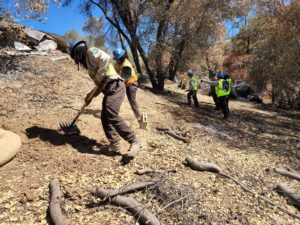
California’s climate-driven wildfires not only destroy lives and structures but also threaten human health and the environment by leaving behind dangerous chemicals and toxic pollutants from burned buildings in their wake. This, combined with wet weather, decreased vegetation and denuded hillsides, creates a dangerous potential for toxic runoff for months, even years after a wildfire is extinguished. Without trees, vegetation, and a stable soil structure to absorb rainwater, tons of ash, debris, heavy metals, and nutrients are more likely to flow directly into watersheds.
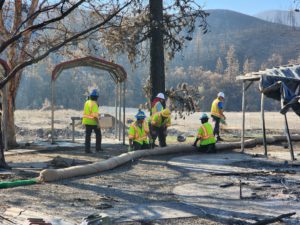 Cal OES works closely with state partners to prevent toxic runoff from entering waterways by installing physical filtration barriers. The placement of these emergency protective measures helps safeguard watersheds from the potential impacts of dangerous toxins found in wildfire ash and debris. By intercepting water flow from slopes, the barriers act as filters to remove dangerous contaminants before they can pollute the waterway.
After a wildfire, a team of flood fight specialists from DWR conduct assessments of damaged or destroyed structures within the burn scar, determining precisely where emergency protective measures should be placed, as well as what type (straw wattles, compost socks, silt fences, etc.). Once the burn scar has been completely assessed by DWR, the CCC deploys Corpsmembers to install the runoff barriers. Similar to the emergency removal of household hazardous waste by the Department of Toxic Substances Control, this process happens automatically and property owners do not need to sign up or submit a Right of Entry Permit.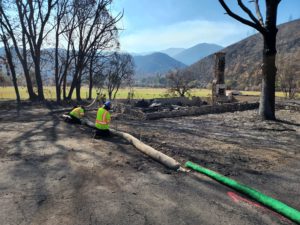
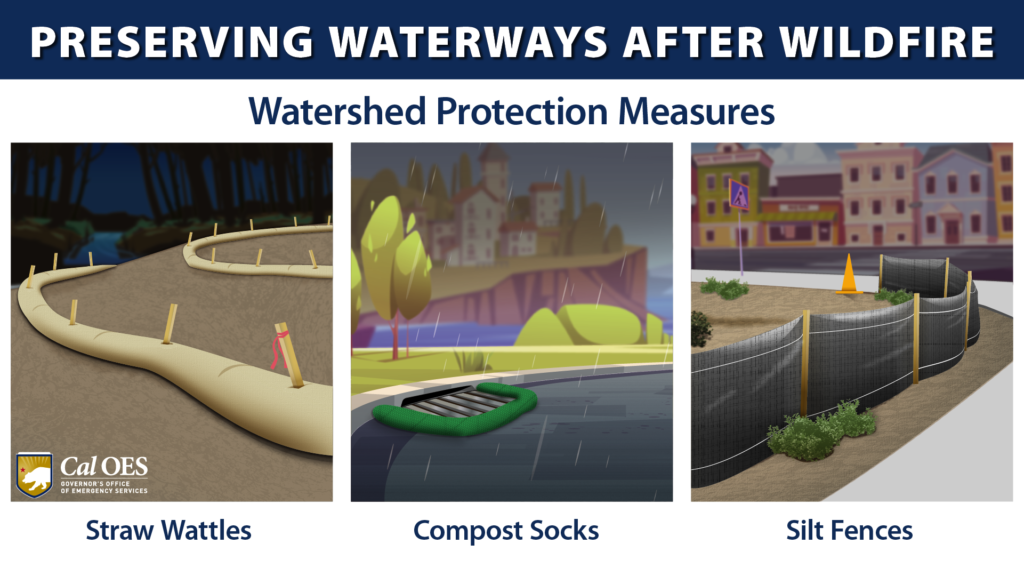
Types of Watershed Protection Measures
- Straw wattles are burlap tubes of compressed straw. They provide perimeter protection along contours or at the base of slopes, inlets, and roadways to reduce soil erosion and runoff, and retain sediment. Straw wattles are also used to intercept water running down a slope. You can use wattles over bare soil or in conjunction with erosion control blankets, on steep slopes, around drains for inlet protection, or as a perimeter control for job sites. Straw wattles are weed-free and help stabilize slopes by slowing, spreading, and filtering overland water flow. They are flexible and conform to the soil surface.
- Compost socks are a type of contained compost filter berm. The filter sock is typically a mesh tube filled with composted material that is placed perpendicular to the direction of sheet flow to control erosion and retain sediment in disturbed areas. A compost filter sock has an oval or round cross-section and provides a three-dimensional filter to retain sediment and other pollutants (e.g., suspended solids, nutrients, metals, and motor oil) and allow clean water to flow through.
- Silt Fences are made of a filter fabric that has been entrenched, attached to supporting poles, and sometimes backed by a plastic or wire mesh for support. The silt fence detains sediment-laden water, promoting sedimentation behind the fence.
The Oak Fire watershed protection mission in Mariposa County started on August 24, with operations wrapping on August 30. Work on watershed protection in Siskiyou County for the McKinney Fire began on September 1 and ended on September 9. Currently, Cal OES, DWR, and CCC are preparing to mobilize for a similar operation for the Mill Fire, also in Siskiyou County. Watershed work for the Mill Fire is slated to start on September 16 and run through September 21.
Additional information on how Cal OES helps protect natural environments after a wildfire can be found here.
Source: Cal OES